
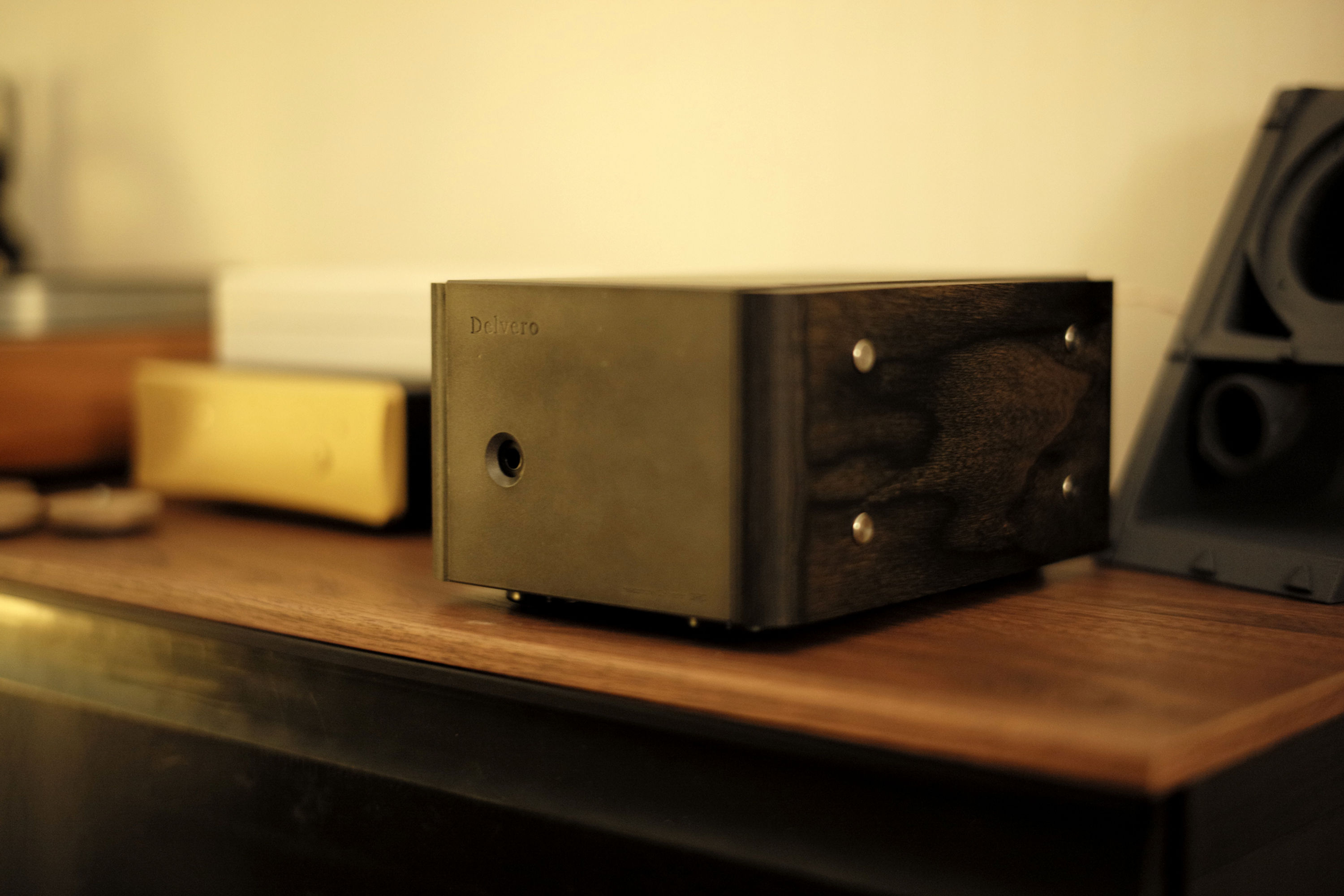
Inspired by the Legendary R10 Converter – Reimagined
In the world of Hi-Fi, the roles seem fixed. Power amplifiers drive loudspeakers, and headphone amplifiers drive headphones.
But from a purely electrical perspective, amplification is simply the controlled delivery of energy.
A power amplifier produces the most complete expression of that energy. Headphones, meanwhile, are among the most sensitive transducers in audio.
Between them lies only one challenge: Energy and load matching.
The Motivation
Many excellent headphone amplifiers exist today. However, most share a similar limitation.
Modern headphones span an enormous range of impedance, sensitivity, and electrical behavior. Designing a single amplifier capable of delivering both sufficient current drive and tonal density across this entire range is inherently difficult.
At the same time, many audiophiles already own exceptional power amplifiers.
Allowing this performance potential to remain unused in a headphone system is a missed opportunity.
More importantly, every power amplifier carries its own sonic signature:
the organic warmth of tube amplification
the speed and precision of solid-state circuits
the density and control of Class-AB output stages
By allowing headphones to be driven directly from these amplifiers, the character of the system can be redefined simply by changing the amplifier itself.
This project was born from a simple idea: to allow power amplifiers to drive headphones safely and accurately, while preserving the full integrity of their sound.
Not Just an Attenuator
Several “speaker-to-headphone adapters” already exist on the market.
Most focus on a single goal: reducing voltage.
Our approach is fundamentally different.
Instead of simply attenuating the amplifier’s output, this design aims to preserve and translate the electrical behavior of the power amplifier.
The goal is not to turn a power amplifier into a headphone amplifier.
The goal is to let headphones behave like loudspeakers.
Impedance Mapping & Energy Integrity
At the core of the design is a carefully engineered impedance-mapping network.
Unlike conventional resistor dividers, which often alter damping factor and introduce phase shifts, this converter maintains a load profile that closely resembles a loudspeaker.
This ensures that the power amplifier continues to operate within its intended electrical conditions.
As a result:
the amplifier’s output stage remains in its optimal operating region
damping behavior remains stable
phase integrity is preserved
dynamic energy delivery remains intact
A virtual load network simulates the electrical behavior of real loudspeakers, allowing the amplifier to “see” a proper load while safely delivering energy to the headphone output.
Additional low-noise isolation and dedicated grounding pathways separate the headphone circuit from the amplifier load network, ensuring extremely low noise and stable operation.
Two Dedicated Output Architectures
To accommodate the vastly different electrical requirements of modern headphones, the converter provides two optimized output paths.
Low-Impedance Output
Designed primarily for traditional dynamic headphones.
This circuit emphasizes:
stable damping
controlled current delivery
precise transient response
The result is exceptional control over dynamic drivers while maintaining tonal density and spatial accuracy.
High-Impedance Output
Optimized for planar magnetic headphones, which typically require significantly higher current drive.
This output preserves the amplifier’s current capability while maintaining safe voltage levels for headphone operation.
The architecture allows demanding planar headphones to fully benefit from the power amplifier’s energy reserves.
Power & Performance
Simulation based on a 100 W / 8 Ω Pure Class-A amplifier shows that at approximately 15% amplifier output, most headphones can easily reach sound pressure levels exceeding 95 dB, while maintaining generous dynamic headroom.
At full amplifier output, virtually all headphones — including extremely demanding models — exceed this level with ease.
When paired with higher-power amplifiers (100 W and above), the available voltage swing and current delivery increase significantly, providing even greater headroom and dynamic authority.
Sonic Character
The difference between a conventional headphone amplifier and a power amplifier driving headphones is not merely volume.
It is fundamentally about energy structure and control.
Most headphone amplifiers prioritize voltage linearity and low distortion, often operating with limited current reserves.
Power amplifiers, by contrast, offer:
significantly higher current density
extremely low output impedance
greater instantaneous energy delivery
Through the converter, headphones receive energy in a manner closer to how loudspeakers are driven.
The result is not simply louder sound.
Instead, listeners often describe:
greater physicality
stronger dynamic stability
more authoritative bass control
a sense of scale rarely experienced in headphone listening
This is precisely what the design seeks to preserve.
Components Without Compromise
This converter was built with a cost-no-object philosophy, using rare and carefully selected components.
Highlights include:
NOS passive components throughout
2 oz gold-plated PCB traces
ultra-low-inductance precision resistor networks
WBT pure silver speaker binding posts
Every element of the circuit was chosen with a single objective: maximum transparency between the power amplifier and the headphone transducer.
A Modern Interpretation of the R10 Converter
The design philosophy is inspired by the legendary Sony R10 headphone converter, but implemented with modern engineering, superior components, and significantly refined impedance modeling.
The result is a device that not only honors the original concept but extends it far beyond its historical implementation.
The Idea
A power amplifier should not be confined to driving loudspeakers.
With the right interface, it can become the most powerful and expressive headphone amplifier imaginable.
This converter simply removes the barrier.
Limited Production
This converter is produced in an extremely limited run.
The current version is built using New Old Stock (NOS) components (which exact R10 uses), many of which are no longer manufactured. And they form an integral part of the converter’s final voicing.
Due to the limited availability of these components, only 10 units can be built in this exact configuration.
Once this batch is completed, future production—if any—will inevitably require different parts. While every effort would be made to maintain the same design philosophy, the sonic signature of the current version cannot be guaranteed with alternative components.
For this reason, the present edition represents a true limited production reference version.
